Who does a historic city belong to: the past, the present, or the future?
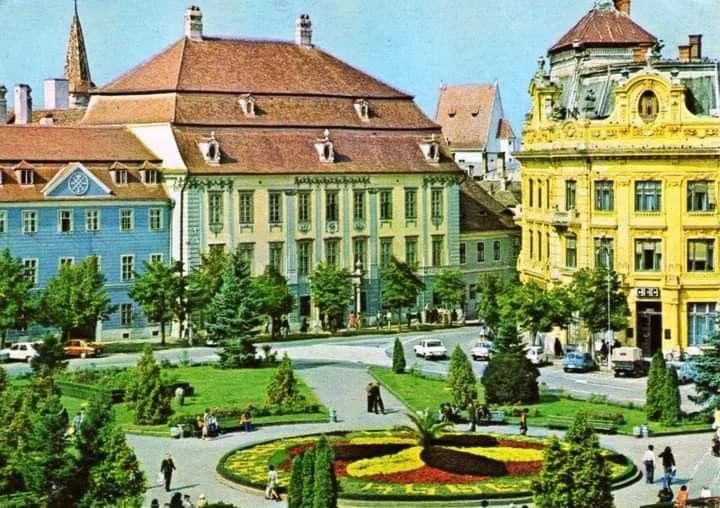
A photograph of Sibiu's Great Square, Piața Mare, offers an apparently simple image: historic buildings, pedestrians, trees, flowers and a public space in which architecture and everyday life coexist. Yet photographs are deceptive witnesses. They preserve what stood before the camera, while remaining silent about what came before, what disappeared afterwards and who made those decisions.
Looking at the trees once present in the square, one might be tempted to ask why they are no longer there. But a more demanding question emerges: when a city restores its historical appearance, whose version of history does it choose to restore? And what happens to the other histories embedded in the same place? These questions are not merely aesthetic. They concern the politics of memory, environmental responsibility, public health, cultural heritage and the relationship between democratic institutions and the people whose lives they shape. They also expose a persistent contradiction in contemporary urban conservation: a city may devote considerable resources to protecting its architectural inheritance while overlooking the environmental conditions that allow people to inhabit and experience it. Can such a city genuinely claim to have preserved its past? Or has it preserved only the parts of the past that can be photographed, admired and marketed?
I. The Myth of the Authentic City
Historic cities are rarely as historically consistent as they appear. Their apparent unity is often the result of centuries of construction, destruction, adaptation and selective restoration. What visitors encounter as an authentic historical environment is frequently a carefully assembled interpretation of different periods. Sibiu's Great Square illustrates this complexity particularly well. According to the municipality's historical documentation, the square existed by 1366 and was subsequently used for trade, public gatherings and judicial punishment. Trees were planted near the Catholic church in 1868, with further lime-tree planting recorded in 1874.
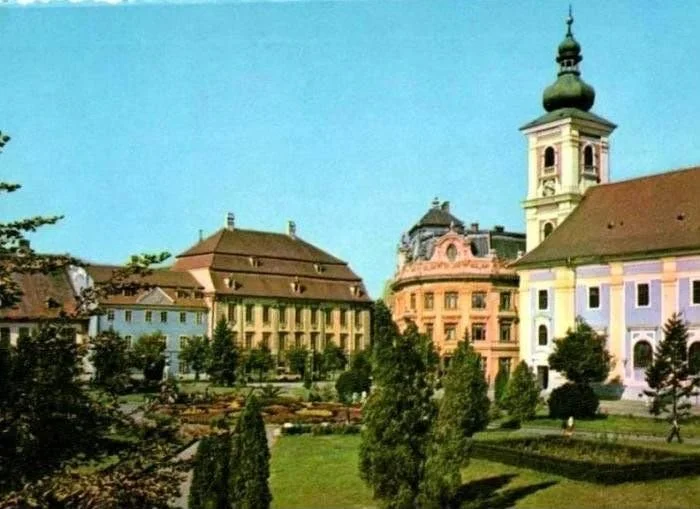
In 1949, the square began to be transformed into a public garden, with paths, flowerbeds and benches. The park was redesigned in 1952 and eventually dismantled during the 1980s. A further major renovation followed in 2005–2006, when the square acquired much of its present paved appearance. Each transformation altered not only the physical setting but also the way people used and understood the space. The medieval marketplace, the nineteenth-century square, the post-war garden, and the contemporary pedestrian precinct represent distinct historical layers.
The language used to justify these choices deserves scrutiny. The municipality's own historical account describes the former park as an unfortunate addition to a medieval square. Such a judgement may reflect a legitimate architectural interpretation, but it is not a neutral historical fact. It expresses a preference. That distinction matters.
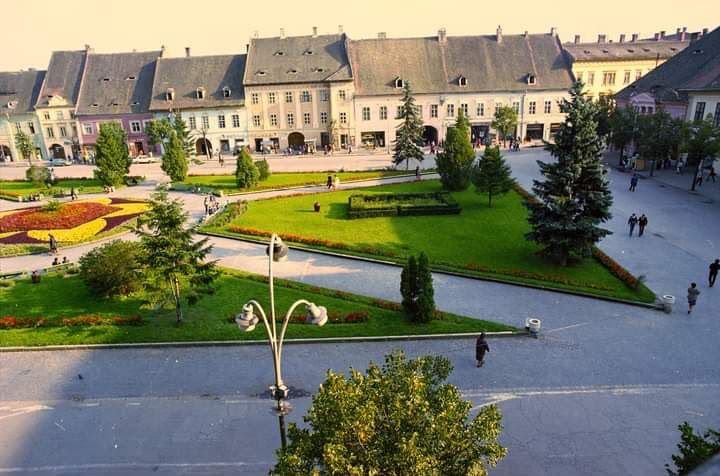
A decision to restore the visual openness of a historic square may be defensible on architectural, archaeological, or functional grounds. But it should not automatically acquire the authority of historical inevitability. After all, nobody seriously proposes restoring the public executions once held in the square. Nor would the presence of historical traffic necessarily justify its return. Why, then, should one particular arrangement of paving, vegetation or public furniture be considered the definitive expression of authenticity?
Authenticity is not necessarily the recovery of one historical moment. It may lie in recognising the continuity of change itself. This is precisely where the UNESCO Recommendation on the Historic Urban Landscape (2011) becomes relevant. UNESCO approaches historic urban environments as the cumulative result of cultural and natural transformations. Heritage encompasses not only buildings and monuments but also gardens, public spaces, geographical conditions, social practices and the meanings communities attach to places.
The implications are profound. A historic city cannot be understood exclusively through its architecture. Its history also survives in patterns of movement, familiar meeting places, ordinary activities, vegetation and the memories of those who have inhabited it. To restore one layer while disregarding the others is not necessarily conservation in its fullest sense. It is historical selection. And selection inevitably raises questions of power.
II. Can a Tree Possess Historical Significance?
A building is readily recognised as a potential historical monument. Its age can be documented, its architecture classified and its material fabric examined. A tree occupies a more ambiguous position. It is biological rather than architectural. It grows, changes, ages and eventually dies. Its physical identity is inseparable from processes of transformation. Yet why should this make it less significant?
An established urban tree may have witnessed generations of inhabitants, political changes, public ceremonies and everyday rituals. Its significance may derive not from exceptional botanical characteristics but from its relationship with a particular place and community. People remember where they sat, whom they met, which path they followed and where they found refuge from summer heat. A tree may therefore become part of a city's lived cultural geography. This does not mean that every tree is a heritage monument, or that vegetation should automatically take precedence over architecture. It means that the historical significance of urban nature cannot be dismissed simply because it does not fit conventional classifications of monumental heritage. The distinction is especially important when discussing living memory.
An archival photograph records a past configuration of space. An established tree can provide continuity between successive generations experiencing that space. But the relationship is not automatic. A tree planted recently may have little historical significance while possessing substantial ecological value. Conversely, a historically important tree may require intervention because of disease or structural instability. Cultural value, ecological value and public safety must therefore be assessed together, without assuming that they always coincide.
The deeper question is whether our methods of heritage conservation are sufficiently sophisticated to recognise forms of significance that cannot be reduced to masonry, stylistic periods or architectural façades. If history is understood as the study of human experience through time, then the environments in which that experience unfolds deserve attention. The tree is not merely a background object in a historical photograph. Sometimes it is part of the history being photographed.
III. A Historic City Must Also Be Habitable
The debate becomes more urgent when environmental science enters the discussion. Trees are not simply visual amenities. They are components of urban ecological infrastructure. The World Health Organization's 2023 report, Assessing the Value of Urban Green and Blue Spaces for Health and Well-being, examines their environmental, social, economic and health-related benefits. These include opportunities for physical activity, psychological restoration, social interaction and reduced exposure to certain environmental hazards. The report also acknowledges the difficulties of assessing these benefits. Access, quality, location and the characteristics of particular spaces influence their value. The existence of greenery alone does not guarantee a healthy urban environment. Nevertheless, the evidence challenges the traditional separation between urban design and public health.
A square is not simply a composition of façades and paving. It is an environment experienced by human bodies. Temperature, exposure to sunlight, air quality, opportunities for rest and the availability of shade influence who can comfortably use it. An elderly resident crossing an exposed square during a heatwave experiences that space differently from a tourist taking photographs on a mild autumn morning. The distinction is neither sentimental nor trivial. It is an issue of environmental equity.
Research published in The Lancet in 2023 by Iungman and colleagues examined the potential health benefits of increasing tree cover across 93 European cities. Using a health-impact assessment based on summer 2015 conditions, the researchers estimated that increasing tree coverage to 30 per cent could have prevented approximately 2,644 premature deaths associated with urban heat. This was a modelled scenario, not a measured result of an intervention, and it cannot be transferred mechanically to Sibiu. Its importance lies elsewhere: urban vegetation can have measurable consequences for population health.
Further evidence comes from the US Geological Survey's 2025 review, Urban Trees and Cooling: A Review of the Recent Literature (2018–2024). Synthesising 115 studies, the review found that trees reduce heat through shade and evapotranspiration, while emphasising substantial differences associated with species, canopy structure, urban geometry, climatic conditions and measurement methods. The scientific conclusion is therefore more sophisticated than the familiar slogan that planting trees makes cities cooler.
The effectiveness of urban vegetation depends upon what is planted, where it is planted, how it is maintained and who can benefit from it.
Moreover, environmental interventions are not without complications. A 2025 study of street trees and air-pollutant concentrations in Rotterdam explored the competing effects of pollutant deposition on foliage and reduced air circulation in street environments. Under certain conditions, dense vegetation may interfere with the dispersion of traffic-related pollutants. This does not undermine the case for urban trees. It strengthens the case for evidence-based planning. A historic square cannot be redesigned responsibly through nostalgia alone. Neither can it be redesigned responsibly through architectural aesthetics alone. Conservation professionals, urban planners, ecologists, public-health researchers and local communities must contribute to the same conversation. And that conversation must acknowledge the difference between making a place visually impressive and making it genuinely liveable.
IV. Who Owns the Historic City?
The second question now becomes unavoidable.
Who does a historic city belong to: the past, the present, or the future?
Legally, ownership may be distributed among private individuals, religious institutions, local authorities, and the state. But ownership in the civic and moral sense cannot be resolved through property law alone. Historic cities are collective inheritances. They are shaped by generations who no longer exist, inhabited by people whose interests frequently conflict and entrusted to decision-makers whose choices will affect those not yet born.
The past possesses claims grounded in cultural significance. The present possesses legitimate needs and rights. The future possesses interests without the ability to participate in contemporary decisions. This imbalance makes urban governance an ethical undertaking. Consider the different expectations placed upon a historic square. A heritage specialist may prioritise the visibility of architectural features.A municipal authority may emphasise events, tourism and ease of maintenance. A business owner may value pedestrian circulation and commercial activity. A resident may seek shade, tranquillity and a place to sit without purchasing anything. A person with reduced mobility may be concerned primarily with accessibility. A child may experience the same square as a space for exploration and play. These positions are not inherently incompatible. Yet they cannot always be accommodated equally. Urban design is therefore never entirely neutral. It establishes practical priorities. It determines which activities are encouraged, which become inconvenient and which groups are most comfortably accommodated.
An exposed, extensively paved square may be highly effective for large cultural events. That does not necessarily make it equally successful as an everyday public environment. A space optimised for occasional spectacle may become less hospitable to ordinary life. This raises an uncomfortable possibility: a city may become increasingly attractive as a destination while becoming less accommodating as a home. However, greater vegetation does not automatically solve questions of social justice. Research on green gentrification, including a 2022 study by Anguelovski and colleagues examining European and North American cities, demonstrates that improvements to urban green infrastructure can become associated with rising property values, social exclusion and displacement. Environmental improvement must therefore be accompanied by concern for affordability, accessibility and the rights of existing communities. Otherwise, the benefits of a greener city may accrue disproportionately to those already best positioned to enjoy them.
The moral question is not simply whether a city should have more trees. It is whether its environmental and cultural resources are managed as genuinely shared goods. Who participates in defining a successful public space? Who benefits from the resulting investment? And who is expected to bear its costs?
V. What Does the Law Require — and What Does It Leave Unanswered?
These questions are no longer confined to philosophical debate.
European and Romanian legislation increasingly recognise the relationship between urban environments, ecological protection and human well-being.
Article 35 of the Romanian Constitution recognises the right to a healthy and ecologically balanced environment.
Law No. 24/2007, governing urban green spaces, establishes responsibilities concerning their administration, protection and maintenance.
Its Article 12 places obligations upon owners and administrators regarding tree maintenance and safety. It also restricts certain interventions in ornamental tree crowns and requires environmental-authority approval before local administrative decisions to remove healthy trees from legally defined urban green spaces are implemented.
These provisions do not prohibit every tree removal.
They do, however, demonstrate that urban trees are not merely decorative objects subject to unrestricted administrative preference.
Their management is a matter of public regulation.
Romania's Law No. 350/2001 on spatial planning and urbanism and Law No. 422/2001 on historical monuments establish another set of responsibilities: those relating to planning, protected areas and cultural heritage.
These legal frameworks pursue objectives that must be reconciled in practice.
Protecting the setting of a monument and protecting urban vegetation should not be treated as mutually exclusive ambitions before site-specific assessments have established the nature of any conflict.
At European level, Regulation (EU) 2024/1991 on nature restoration introduces obligations concerning urban green space and tree-canopy cover.
Article 8 requires Member States, subject to the Regulation's applicable conditions, to ensure no net loss in the relevant total national urban green-space area and tree-canopy cover by the end of 2030 compared with 2024.
From 2031, the framework requires increasing trends in specified urban ecosystem indicators.
Crucially, the initial no-net-loss requirement operates at national aggregate level. It does not mean that every individual historic square is legally required to retain an identical number of trees.
This distinction reveals a limitation in relying exclusively on legal compliance.
A city might contribute to an acceptable national statistical outcome while particular neighbourhoods experience significant environmental losses.
A national balance sheet cannot necessarily explain whether a person has lost the only substantial shade available along a daily walking route.
Nor does a newly planted sapling immediately replace the ecological functions of a mature tree.
The European Commission's Urban Nature Platform acknowledges the importance of integrating urban greenery with climate adaptation, public health, biodiversity and participatory planning.
The direction of European policy is clear: urban nature is increasingly understood as essential infrastructure.
Yet legislation alone cannot determine the appropriate relationship between architecture, vegetation and social use in every historic setting.
That requires transparent evaluation and public reasoning.
The right to participate in environmental decisions is also supported by the Aarhus Convention, ratified by Romania through Law No. 86/2000, while Law No. 52/2003 establishes general requirements concerning transparency in public administration.
Public consultation, however, must mean more than the formal opportunity to submit observations.
A genuinely deliberative process should demonstrate how evidence, competing values and public contributions affected the eventual decision.
The existence of consultation is not, by itself, proof that all relevant interests were adequately considered.
VI. Sibiu: Between Regulation and Responsibility
Sibiu provides a concrete setting in which these principles can be tested.
The municipality approved a regulation for the protection, conservation, development and maintenance of green spaces through Local Council Decision No. 150/2022.
Its local green-space register was subsequently updated, including through Decision No. 387/2025, which recorded 9,100 inventoried trees within the register's scope.
That figure is useful, but it cannot independently establish the ecological condition of the city.
A numerical inventory does not reveal sufficient information about canopy extent, age, tree health, accessibility to shade or the unequal distribution of vegetation.
Ten mature trees and ten young saplings may satisfy the same simple numerical count while providing very different levels of ecological service.
The distinction between counting trees and evaluating their benefits is fundamental.
Sibiu also has a municipal climate mitigation and adaptation strategy, published in 2022.
More recently, Local Council Decision No. 190 of May 2026 approved protected-area urban planning documentation for the Great and Small Squares, including provisions accommodating planted spaces and referring to plans for circulation and greenery.
The city's updated General Urban Plan was approved through Decision No. 216 in June 2026.
These documents establish an important basis for asking how urban conservation and climate adaptation are being coordinated.
But their existence should not be mistaken for evidence that every resulting intervention has achieved its intended environmental or social outcomes.
Those outcomes require evaluation.
For a historic square, meaningful assessment might consider several questions:
What historical periods and forms of spatial organisation have been documented?
Which elements of the existing landscape possess cultural significance?
What are the actual thermal conditions of the space during increasingly frequent hot periods?
How much shade is available, at what times of day, and to whom?
What are the archaeological and structural constraints upon tree planting?
Could alternative landscape designs improve comfort without compromising significant architectural views?
How are local residents involved in defining the function and identity of the square?
Such questions require more than an opposition between preservationists and environmentalists.
They require an understanding of the city as a complex system in which historical, ecological and social processes interact.
The aim should not be to reconstruct the garden visible in an old photograph simply because it inspires affection.
That would risk replacing one selective interpretation of history with another.
Nor should the architectural significance of the square be invoked as a sufficient reason to exclude consideration of contemporary environmental needs.
A more intellectually defensible approach would examine historical evidence, alternative design scenarios, climate data, archaeological constraints and patterns of public use together.
The resulting decision might preserve a largely open square while introducing carefully positioned vegetation, shaded resting areas or other climate-adaptation measures.
It might also justify maintaining particular views without planting trees in certain locations.
The essential requirement is that such choices be argued, documented and evaluated.
Neither nostalgia nor architectural orthodoxy should substitute for evidence.
VII. The Responsibility of Those Who Inherit
Perhaps the most difficult aspect of historic urban conservation is its relationship with time.
The people who built a city's monuments are no longer present to explain their intentions.
The people who use those monuments today interpret them through contemporary values and needs.
Those who will inhabit the city decades from now cannot participate in decisions that may determine their environmental conditions.
This makes the idea of absolute ownership inadequate.
The past cannot own the city because it cannot govern the living.
The present cannot possess it without limitation because its decisions may create irreversible losses.
The future cannot claim direct political representation, yet its interests are no less real.
What emerges is not ownership, but stewardship.
To act as a steward is to recognise that an inherited environment contains values that exceed immediate convenience, political preference or commercial opportunity.
This principle applies equally to architectural heritage and ecological systems.
A historic façade may require specialised conservation to survive another century.
An urban tree may require decades of suitable growing conditions before it develops a substantial canopy.
Both demand forms of care whose benefits extend beyond a single political mandate.
Yet there is an important difference.
Architecture can sometimes be reconstructed, even if reconstruction cannot entirely recover historical authenticity.
A living ecosystem cannot simply be recreated through the replacement of individual objects.
Its biological relationships, accumulated growth and ecological functions develop over time.
This temporal dimension should inform environmental decision-making.
The promise to replace mature trees with new planting may be sincere, but it must acknowledge the interval during which ecological benefits will be diminished.
Future compensation does not eliminate present loss.
Similarly, the commitment to conserve monumental architecture must be assessed against the conditions necessary for future generations to experience it.
A building may survive physically while the public environment around it becomes increasingly uncomfortable or inaccessible.
Conservation without habitability risks producing a paradox: the successful survival of historic structures within an unsuccessful urban environment.
VIII. What, Then, Are We Preserving?
The photograph of Sibiu's Great Square invites a final reconsideration.
At first sight, it appears to document architecture accompanied by trees.
Closer examination suggests something more complicated: successive generations have repeatedly altered the square according to changing political values, aesthetic preferences and ideas of public life.
The vegetation itself has a history.
So does its removal.
So does the decision to describe one historical configuration as appropriate and another as an intrusion.
The square is therefore not simply a preserved fragment of the past.
It is a continuing argument about what the past should mean.
This is not a reason to reject conservation. On the contrary, it is a reason to demand greater intellectual honesty from it.
Historical authenticity cannot be reduced to the elimination of everything that appeared after an arbitrarily selected date.
Environmental responsibility cannot be reduced to the numerical replacement of trees.
Democratic participation cannot be reduced to the completion of a consultation procedure.
And the public interest cannot be reduced to the attractiveness of a city in promotional photographs.
The deeper challenge is to recognise that cities contain several forms of inheritance simultaneously.
Their architecture preserves material traces of human ambition and imagination.
Their public spaces preserve changing forms of social life.
Their natural environments sustain biological processes upon which human habitation depends.
None can be understood adequately in isolation.
So, can a city preserve its past while erasing its living memory?
It can certainly preserve buildings while transforming or destroying the social and ecological relationships that once gave them meaning.
Whether that constitutes successful conservation is another matter.
And who does a historic city belong to: the past, the present, or the future?
Perhaps the answer is that it belongs exclusively to none of them.
The past deserves understanding.
The present deserves a liveable environment and a meaningful voice in its governance.
The future deserves the possibility of inheriting both.
A historic city is not an object completed by previous generations and subsequently entrusted to us for display.
It is a living inheritance whose continued existence depends upon choices made in the present.
The real measure of conservation may therefore be neither how faithfully a city resembles a chosen image of its past nor how successfully it accommodates the demands of the present, but how responsibly it allows both history and life to continue.
And perhaps that is the most uncomfortable question of all:
What are we willing to erase in order to preserve what we have decided to call history?
References and further reading
Historical research and heritage
Municipality of Sibiu. Piața Mare Sibiu: Historical Overview. Municipal heritage documentation.
Municipality of Sibiu. The Year 1986: Historical Chronology.
Romanian National Cultural Heritage Institute (CIMEC). The Park in Sibiu's Great Square, Andrei Ștomff Collection.
UNESCO (2011). Recommendation on the Historic Urban Landscape, Including a Glossary of Definitions.
Environmental science, public health and social justice
WHO Regional Office for Europe (2023). Assessing the Value of Urban Green and Blue Spaces for Health and Well-being.
Alonzo, M., Ibsen, P. C. and Locke, D. (2025). ‘Urban Trees and Cooling: A Review of the Recent Literature (2018 to 2024)’. Arboriculture & Urban Forestry.
Iungman, T. et al. (2023). ‘Cooling Cities Through Urban Green Infrastructure: A Health Impact Assessment of European Cities’. The Lancet, 401, pp. 577–589.
‘Cooling Efficacy of Trees Across Cities Is Determined by Background Climate, Urban Morphology, and Tree Trait’ (2024). Communications Earth & Environment.
Anguelovski, I. et al. (2022). ‘Green Gentrification in European and North American Cities’. Nature Communications.
‘Effect of Street Trees on Local Air Pollutant Concentrations (NO₂, BC, UFP, PM₂.₅) in Rotterdam, the Netherlands’ (2025). Environmental Science: Atmospheres.
European and Romanian law and policy
European Commission. Urban Nature Platform.
European Parliament and Council (2024). Regulation (EU) 2024/1991 on Nature Restoration, particularly Article 8.
Romania. Constitution of Romania, Article 35.
Romania. Law No. 24/2007 on the Regulation and Administration of Urban Green Spaces.
Romania. Law No. 422/2001 on the Protection of Historical Monuments.
Romania. Law No. 52/2003 on Transparency in Public Administration.
Local planning and climate governance
Sibiu Local Council (2022). Decision No. 150/2022: Regulation on the Protection, Conservation, Development and Maintenance of Green Spaces.
Municipality of Sibiu (2022). Climate Change Mitigation and Adaptation Strategy and Plan.
Sibiu Local Council (2025). Decision No. 387/2025: Update of the Local Green-Space Register.
Sibiu Local Council (2026). Decision No. 190/2026: Protected-Area Urban Plan for the Great and Small Squares.
Sibiu Local Council (2026). Decision No. 216/2026: Updated General Urban Plan and Local Urban Planning Regulation.